CredR Refurb

How a warehouse redesign stopped a $1.83 million profit leak.

How a warehouse redesign stopped a $1.83 million profit leak.

How a warehouse redesign stopped a $1.83 million profit leak.

Role

Interaction Designer

Team

1 PM, 2 Flutter devs, 1 backend dev, 1 designer

Duration

6 months

Platform

Flutter, Android + iOS

Role

Interaction Designer

Duration

6 months

Team

1 PM, 2 Flutter devs, 1 backend dev, 1 designer

Platform

Flutter, Android + iOS

Role

Interaction Designer

Team

1 PM, 2 Flutter devs, 1 backend dev, 1 designer

Duration

6 months

Platform

Flutter, Android + iOS

Results

$0M

$0M

Projected annual savings across 60+ stores

0%

0%

Faster end-to-end cycle

Faster end-to-end cycle

0%

0%

Fewer taps per bike
1,440 reduced to ~700

Fewer taps per bike
1,440 reduced to ~700

CredR operates an extensive retail footprint with a network of over 60+ active showrooms and franchised brand stores

Operational in Delhi NCR, Jaipur, Bhilwara, Chittorgarh, Sikar, Pune, and Bengaluru

About
CredR is India's most trusted used two-wheeler marketplace, a full-stack, vertically integrated platform connecting buyers and sellers through a network of stores, warehouses, and a quality-controlled digital pipeline.

CredR is India's most trusted used two-wheeler marketplace, a full-stack, vertically integrated platform connecting buyers and sellers through a network of stores, warehouses, and a quality-controlled digital pipeline.

Overview

CredR's quality promise runs through one workflow. It was failing. Every bike clears through Refurb: 144 checkpoints, 9 stages, 7 mechanics, 2 managers, 250-300 bikes per cycle.

CredR's quality promise runs through one workflow. It was failing. Every bike clears through Refurb: 144 checkpoints, 9 stages, 7 mechanics, 2 managers, 250-300 bikes per cycle.

On paper, it worked. In practice, the team cleared 14 bikes a day against a target of 25, a shortfall of 80-100 units per cycle, a $42,000 revenue loss.

On paper, it worked. In practice, the team cleared 14 bikes a day against a target of 25, a shortfall of 80-100 units per cycle, a $42,000 revenue loss.

A cycle runs 10 to 15 days depending on supply.

Every bike undergoes a 144 point quality inspection covering odometer accuracy, accidental history, and engine health.

Nine stages in Refurb. Each stage had a purpose.

Even with a dedicated app, the mechanic still does the heavy lifting: diagnosing through the form and reporting the process for both digital tracking and offline records of the vehicle.

Research

You can't design for a floor you've never stood on. After an initial PM briefing, we insisted on restricted-floor access with the manager and CTO. We Ran each task alongside the mechanics, mapped inbound to outbound into a service blueprint, no documentation had existed before this.

You can't design for a floor you've never stood on. After an initial PM briefing, we insisted on restricted-floor access with the manager and CTO. We Ran each task alongside the mechanics, mapped inbound to outbound into a service blueprint, no documentation had existed before this.

Observed people using the application in person, and the frustration was noticeable even while doing the tasks ourselves. The app was 12 years old, and it showed: complex flows, tap targets undersized for hands that were greasy and oily, and the same worker switching between different login IDs just to move a lead forward.

"I repeat doing the same thing again and again, spend less time on actual diagnosis, and just press checkboxes."
— Mechanic, CredR Refurb floor

Observed people using the application in person, and the frustration was noticeable even while doing the tasks ourselves. The app was 12 years old, and it showed: complex flows, tap targets undersized for hands that were greasy and oily, and the same worker switching between different login IDs just to move a lead forward.

"I repeat doing the same thing again and again, spend less time on actual diagnosis, and just press checkboxes."
— Mechanic, CredR Refurb floor

We traced every pointer against ground reality, vehicle by vehicle, mapping it against the app flows workers actually used. Each stage only activated once the previous one was completed and logged, giving us a clean, timestamped record of exactly where time was going, stage by stage,

We traced every pointer against ground reality, vehicle by vehicle, mapping it against the app flows workers actually used. Each stage only activated once the previous one was completed and logged, giving us a clean, timestamped record of exactly where time was going, stage by stage,

We traced every pointer against ground reality, vehicle by vehicle, mapping it against the app flows workers actually used. Each stage only activated once the previous one was completed and logged, giving us a clean, timestamped record of exactly where time was going, stage by stage,

We traced every pointer against ground reality, vehicle by vehicle, mapping it against the app flows workers actually used. Each stage only activated once the previous one was completed and logged, giving us a clean, timestamped record of exactly where time was going, stage by stage,

The Challenge

Back at the office, we reconstructed the full workflow map with the PM, analytics team, and key stakeholders.

Using time-on-task data  and other metrics tracked at each stage, we built a clear picture of where bikes were stalling in the refurb process and why. That data gave us something more useful than a list of complaints: it gave us a hierarchy of friction, ranked by cost.

Considering the learnings we had, we had to ask the right questions. After trying and questioning several angles, we narrowed down to four questions that solved the issue the way we expected.

That reframing changed everything. We weren't designing better auditability. We were designing a system where the right path was always the fastest one.

Challenge 1

How might we surface only the checkpoints that matter for this specific bike, at this specific stage, without asking the mechanic to filter through the ones that don't?

How might we surface only the checkpoints that matter for this specific bike, at this specific stage, without asking the mechanic to filter through the ones that don't?

Challenge 2

How might we consolidate role-based workflows so one person can complete their full scope of work without leaving the task context?

How might we consolidate role-based workflows so one person can complete their full scope of work without leaving the task context?

Challenge 3

How might we surface parts pricing and reparability data at the exact moment a decision needs to be made?

How might we surface parts pricing and reparability data at the exact moment a decision needs to be made?

Challenge 4

How might we design an interface that reduces cognitive load and physical friction for workers completing high-volume, repetitive flows across a full shift?

How might we design an interface that reduces cognitive load and physical friction for workers completing high-volume, repetitive flows across a full shift?

Field research, synthesis, and interviews surfaced more friction than expected. We ran affinity mapping, clustering insights by relevance and frequency, then built a priority map. Three challenges rose to the top, each needing its own intervention, working together.

Process

we begin analysing how to get the goals for the project to achieve the desired result. Trying and questioning on different aspects after several ways we concluded down to  focus on solving the 4 questions that solved the issue as the ways expected on.

we begin analysing how to get the goals for the project to achieve the desired result. Trying and questioning on different aspects after several ways we concluded down to  focus on solving the 4 questions that solved the issue as the ways expected on.

Challenge 1

How might we collapse 90 days of fragmented research into a planning experience that generates a usable and trustworthy itinerary instantly ?

How might we collapse 90 days of fragmented research into a planning experience that generates a usable and trustworthy itinerary instantly ?

Challenge 2

How might we synthesise a scattered stack of Maps, Weather, Notes, and Document Attachments into a single, Unified "One-View" Touchpoint that keeps the entire journey organised and shareable?

How might we synthesise a scattered stack of Maps, Weather, Notes, and Document Attachments into a single, Unified "One-View" Touchpoint that keeps the entire journey organised and shareable?

Challenge 3

How might we replace generic, one-size-fits-all itineraries with a planning experience that understands a traveler's unique preferences, pace, and style from the very first interaction?

How might we replace generic, one-size-fits-all itineraries with a planning experience that understands a traveler's unique preferences, pace, and style from the very first interaction?

We traced every pointer against ground reality, vehicle by vehicle, mapping it against the app flows workers actually used. Each stage only activated once the previous one was completed and logged, giving us a clean, timestamped record of exactly where time was going, stage by stage

We traced every pointer against ground reality, vehicle by vehicle, mapping it against the app flows workers actually used. Each stage only activated once the previous one was completed and logged, giving us a clean, timestamped record of exactly where time was going, stage by stage

Design system

Five decisions that changed how the floor works.

Five decisions that changed how the floor works.

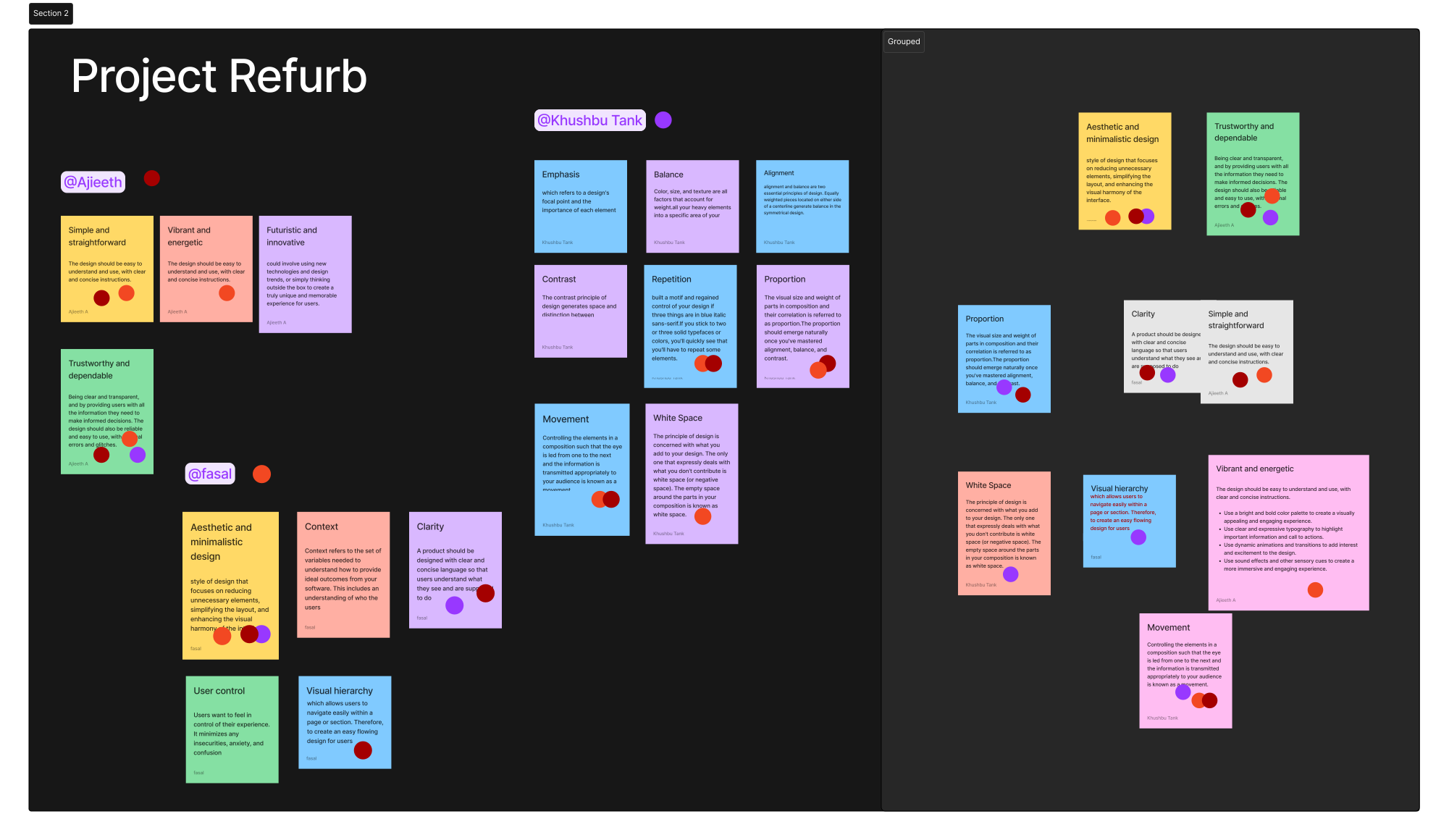
A redesign without a system is just a reskin. Refurb was designed as the foundation for every internal tool CredR builds next, with systems thinking from day one, not retrofitted at the end. Ideation ran with the internal design team and stakeholders.
Challenge 2

A redesign without a system is just a reskin. Refurb was built as the foundation for every internal tool CredR builds next, with tokens, a purpose-built component library, and five anchoring principles evaluated before anything shipped.

Colour was chosen in the warehouse, not the design tool, dark palettes failed under oil-reflected glare, so high-contrast light interfaces won. Every decision, from hit targets to token values, was validated where it would actually be used.

Solution

Five decisions that changed how the floor works.

The old system re-checked all 144 points at every stage. We locked confirmed sections after QC and JC cleared them, with a dispute path back if something was missed, cutting repetition by 60%.

Challenge 1

Field-flagged issues now map directly into QC as "Must Check." A wizard-like flow auto-filters checkpoints by vehicle type and condition, using failure patterns from the highest-volume models to set the default logic.

Challenge 2

Real-time parts pricing and task status moved into a single in-app layer, ending the phone-based back-and-forth between mechanics, QC, and supply. Reparability decisions could now be made in context, the moment they were needed.

Challenge 3

Other Projects

© 2026 Ajieeth. All rights reserved.

Thinking different...

© 2026 Ajieeth. All rights reserved.

Thinking different...

© 2026 Ajieeth. All rights reserved.

Thinking different...